



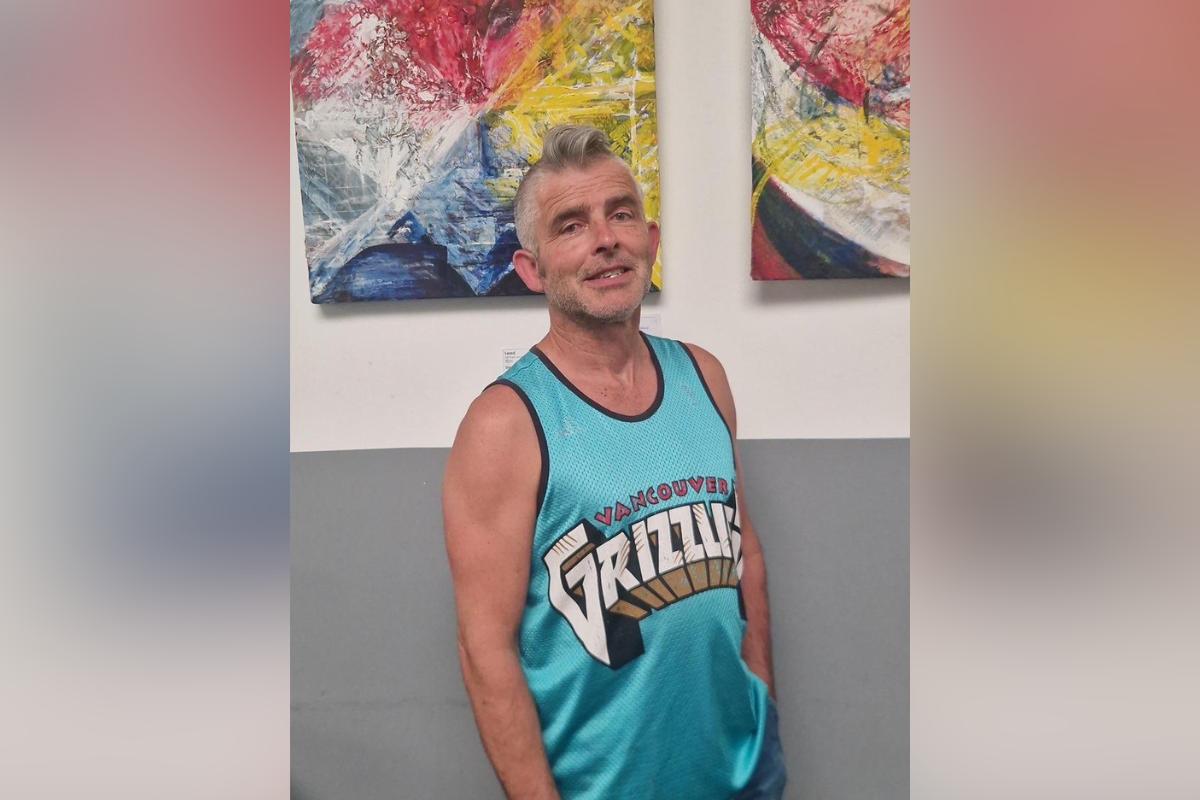

Art was never my strongest subject, and if my old art teacher ever stumbled across this piece, I suspect he would be quietly nodding in agreement.
That is partly why I approached Stephen Pedley’s exhibition at Bourne Hall in Ewell with a bit of caution.

Abstract art has never come naturally to me, and reporting on interviews and current events usually feels far more straightforward than trying to unpack paintings built from colour and texture alone.
But that is exactly where Circles: Directions to Paradise begins to make sense.

You do not need to be an art critic to engage with it.
The exhibition is currently displayed along the walls of Bourne Hall’s café in Ewell, running until June 6.
People sit with coffees and lunches, chatting beneath works that wrestle with truth, trust, wisdom, treachery and limbo.
It is an unusual backdrop for such heavy ideas, but Pedley’s work is grounded in the belief that these questions belong in ordinary, everyday spaces.
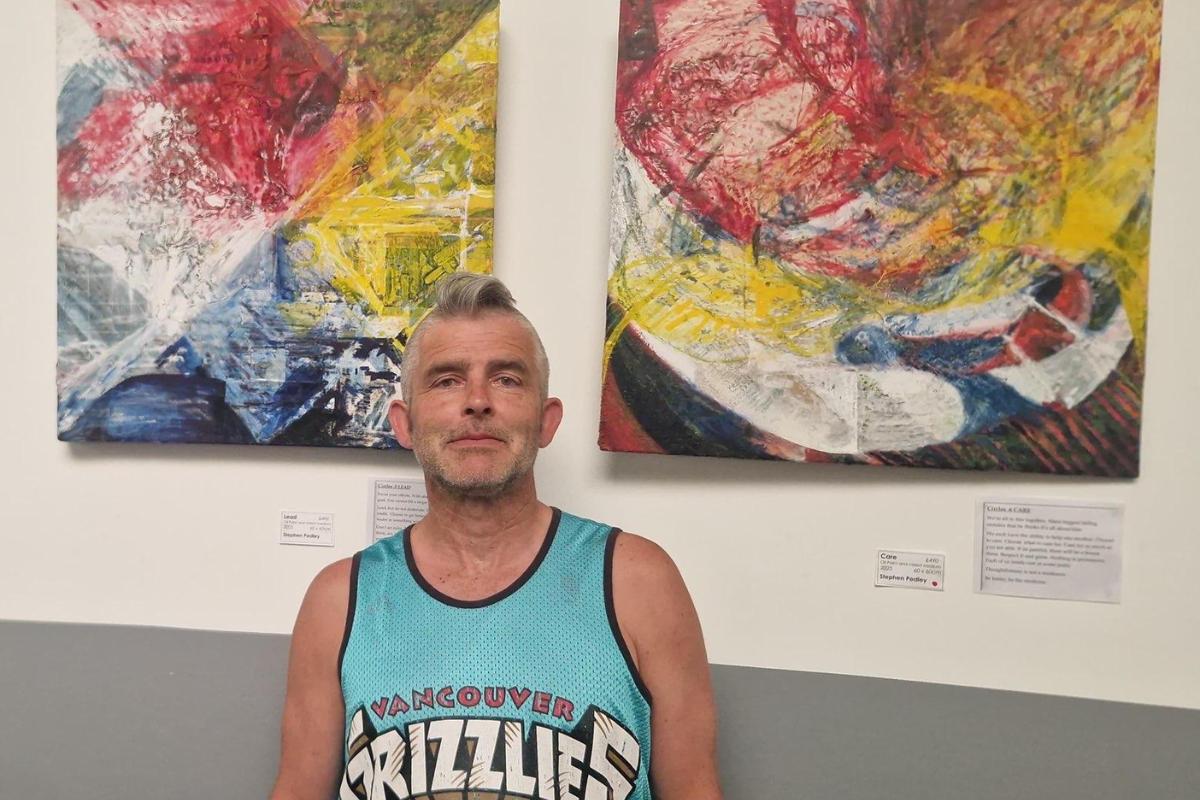
Pedley, who lives and works in the sweet Surrey town of Ewell, has been painting since the 1990s and has exhibited across London and the West Country.
His pieces often take months to complete, built up in layers of oil paint and mixed media that are repeatedly scraped back and reworked until the surface takes on an almost sculpted feel.
Up close, that process is unmistakable.
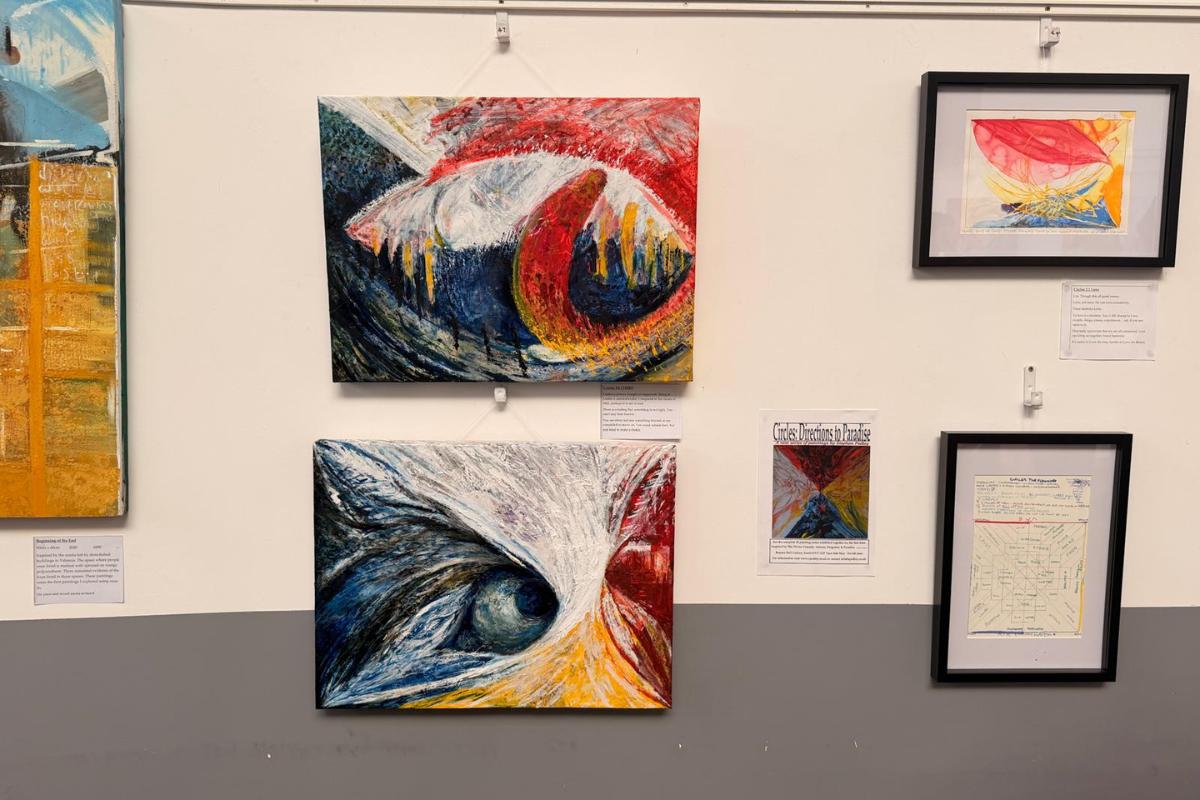
These are not smooth or decorative works, but deep blues clashing with vivid yellows and reds, while ridges of paint catch the light and shift as you move past them.
There is a strong sense of time embedded in the surfaces, as though each canvas has been thought through, questioned, and reworked rather than resolved quickly.
I was told that Stephen often works late into the night, returning to the same pieces over long stretches until they feel finished.
What emerges is less a series of images and more a series of ideas made visible.
His work is rooted in human behaviour: truth, trust, wisdom, pride, wrath and lust among them.
Each painting is paired with a short-written reflection, extending the work beyond the visual into something more contemplative.
His intention is clear: he wants viewers to look, read and begin questioning their own habits and ways of thinking, something he reinforced when speaking to us at the end of the exhibition.
Moving through the café, it quickly becomes apparent that you are not meant to leave with neat answers, but with questions that linger.
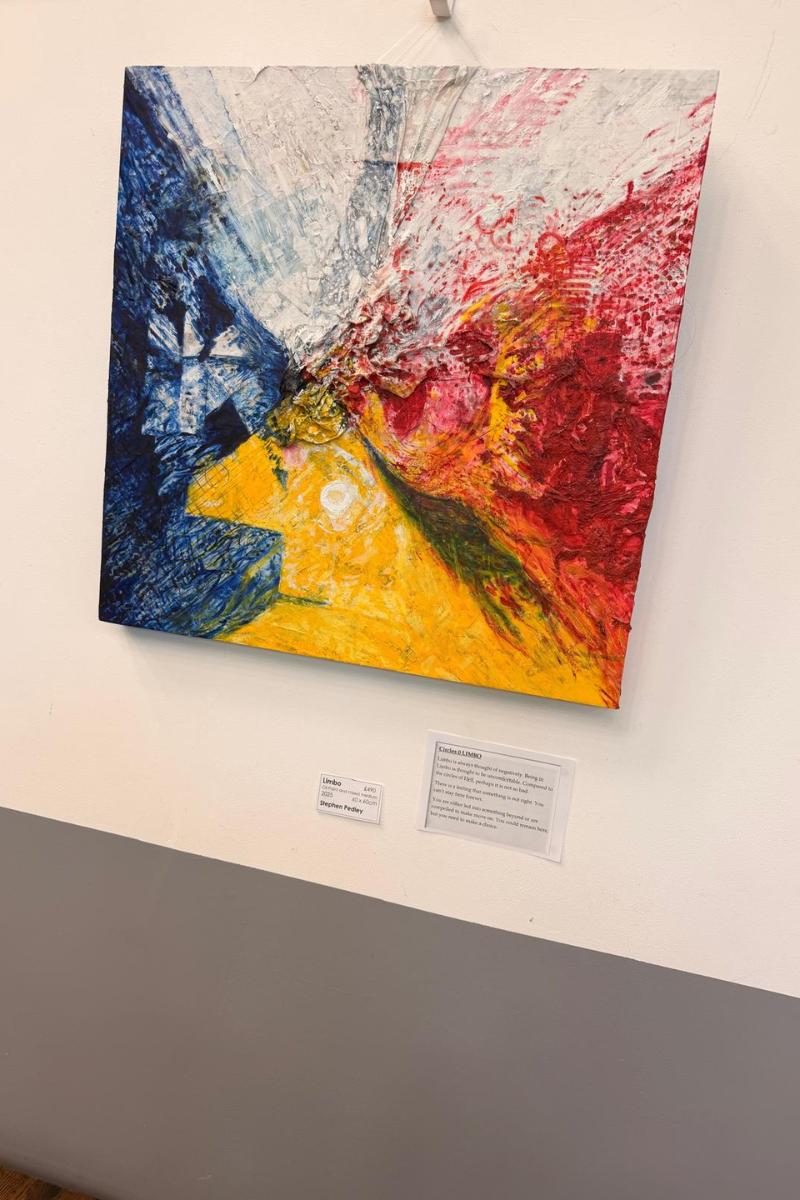
One of the first works that stands out is Limbo, with its blues, yellows and reds pressed against layers of white and grey.

The surface feels unsettled, as if suspended mid-movement.
The title fits: there is a sense of being caught between states, and that uncertainty feels intentional rather than accidental.
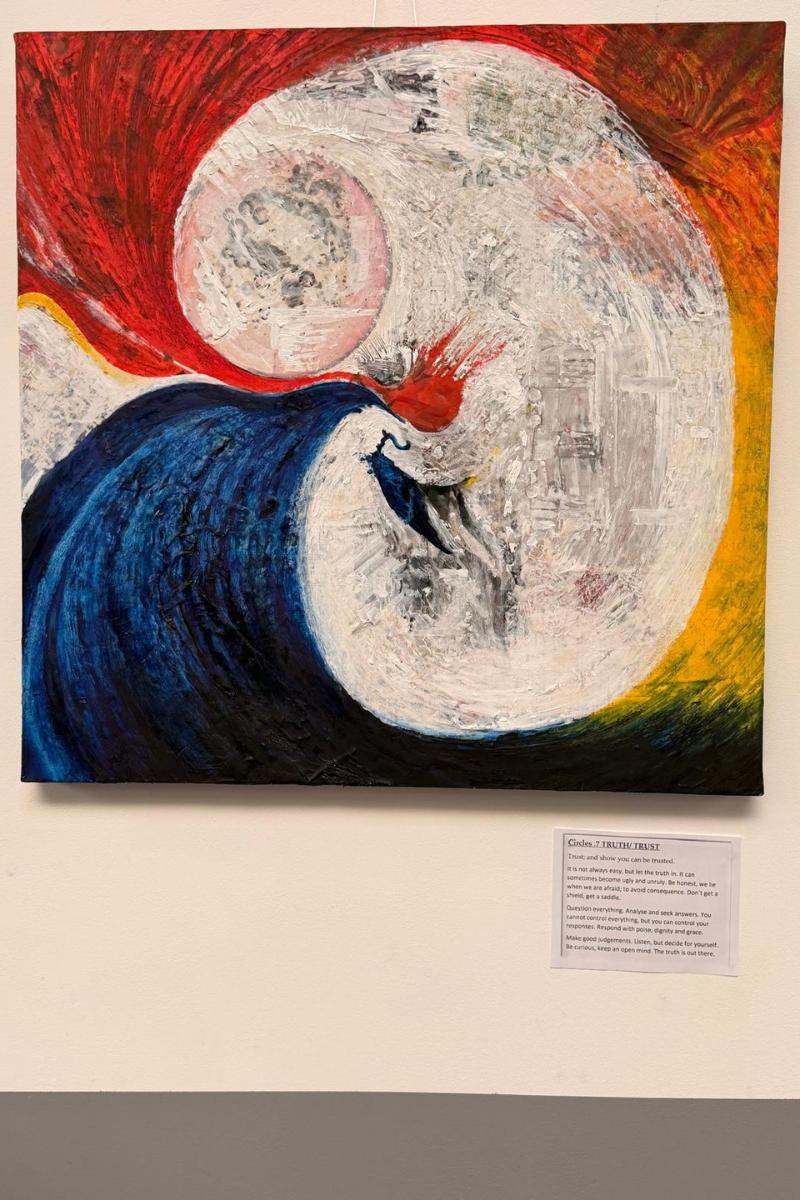
Another piece, Circles .7 Truth/Trust, feels like the centre of gravity in the exhibition.
A swirling form dominates the canvas, somewhere between a whirlpool and an eye.

Blues spiral inward, reds arc across the surface and yellows cut through it.
The accompanying reflection turns to honesty, trust and truth.
It acknowledges that truth is not always comfortable, and that people lie out of fear.
Difficult realities are often avoided because they can threaten security or force a confrontation with consequences most would rather not face.
One idea stands out: instead of a shield to protect us from truth, we are given a saddle.
The task is not avoidance but learning how to stay with it.
In Circles .4 Wisdom, a red triangular form pushes through layers of yellow, white and blue, creating a sense of force and motion.

The reflection frames wisdom as something deeper than knowledge alone.
Knowledge can be learned, but wisdom develops over time through judgement, experience and reflection.
It carries a quiet reminder that certainty and correctness are not always the same thing.
Another piece turns to treachery, accompanied by a line which still remains with me: when you close your eyes, you are the only one left in the room.
At first, it feels simple, but it quickly turns uneasy.
When everything else falls away, you are left alone with your conscience, so no background noise or distractions.
This ties into the exhibition’s wider exploration of the Seven Deadly Sins.
Rather than treating pride, wrath, sloth, lust and gluttony as distant moral ideas, Pedley presents them as everyday human tendencies.
He is not simply producing abstract paintings for display; he is trying to prompt reflection.
More than that, he hopes people leave questioning habits and assumptions they may not have examined closely before.
Whether every visitor does that is impossible to know.
What is clear is that I walked into Bourne Hall unsure how to read abstract art, and left thinking about honesty, conscience and the choices we make.
For an exhibition built around questions rather than answers, that feels like a quiet success.
I still would not call myself an art expert, and I cannot speak fluently about movements or theory.
But I do know this: Stephen Pedley’s work stayed with me after I left.
Not because every brushstroke made perfect sense, but because the questions behind them did.
The exhibition runs until Saturday.


Share